Crawling your site
How to run a crawl, what Meelu reads, how to follow the progress and how the site stays up to date.
A crawl is when Meelu visits your website and reads its pages, one by one, like a search engine does. Every screen on the Site desk is built from what the crawl read. If the crawl is old, the screens are old too.
Crawling runs in the desktop app
The crawl runs in the Meelu desktop app, from your own computer. Keep the app open while a crawl runs. A crawl uses no credits.
Run your first crawl
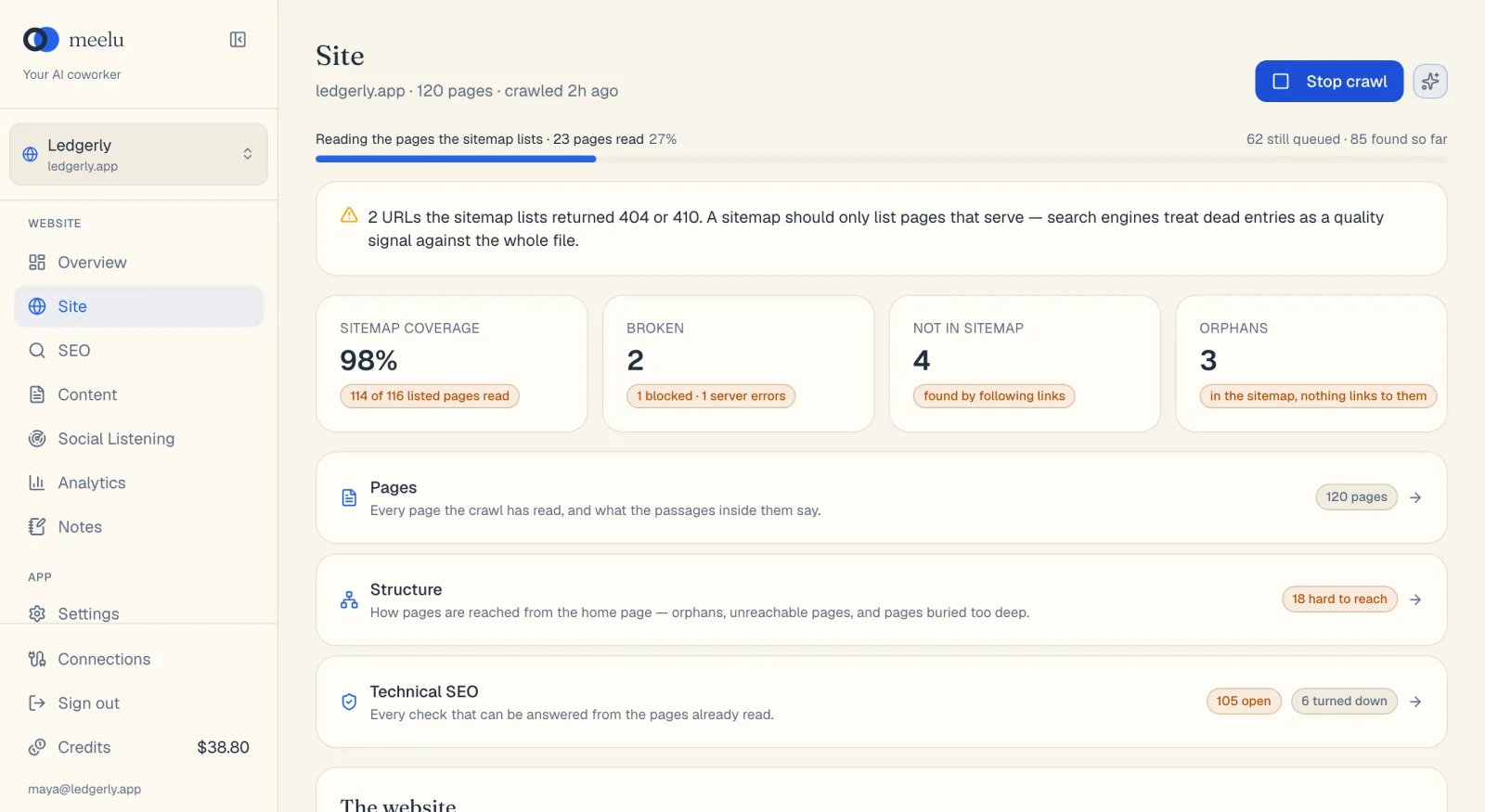
Open the Site desk
Open the Meelu desktop app and click Site in the sidebar.
Click Crawl website
Click Crawl website at the top right. If the site has been crawled before, the button says Crawl again.
Watch the progress bar
A progress bar shows which step the crawl is on and how many pages it has read. You can keep working in other desks while it runs.
Read the result
When the crawl ends, a short note says how many pages were read. The four numbers on the Site screen and the Pages, Internal links and Technical SEO screens update.
What the crawl reads
The crawl starts from your sitemap. A sitemap is a file on your site, often at /sitemap.xml, that lists the pages you want search engines to find. If you have not given Meelu a sitemap, it looks in the usual places for one.
The crawl works in three steps. The progress bar names the step it is on:
| Step shown | What is happening |
|---|---|
| Reading the sitemap and robots.txt | Meelu reads your sitemap and your robots.txt. robots.txt is a file that tells crawlers which pages they may read. |
| Reading the pages the sitemap lists | Meelu reads every page in your sitemap. |
| Following links the sitemap did not list | Meelu follows links on your pages to find pages your sitemap left out. |
Some limits to know:
- Up to 10,000 pages per crawl. If your sitemap lists more, the crawl stops there and does not follow links. A note tells you so.
- Link-following is capped. The crawl reads at most twice as many extra pages as your sitemap lists, so extra pages never crowd out the ones you listed.
- Only your own site. Links to other websites are recorded but not read.
- Pages robots.txt blocks for Google are not read. Meelu records them, because Google will not read them either.
Pages Meelu skips
Some pages are read but marked as not worth studying. They show a grey badge in the Pages table:
| Badge | Why |
|---|---|
| legal | Privacy, terms, cookie or refund pages. |
| pagination | Page 2, 3 and so on of a list. |
| thin | Fewer than 80 words of text. |
| redirect | The address sends the visitor to another page. |
If no sitemap is found
If Meelu cannot find a sitemap, a box appears under the crawl button. Paste your sitemap's full address, such as https://example.com/sitemap.xml, and click Use this sitemap. Meelu crawls with it and remembers it for later crawls. You can also add sitemaps in the website record.
If your firewall blocks the crawl
The crawl reads your site from your computer, so a firewall or bot protection may treat it as a bot and block it. To let it through, use the Crawl access token in the website record.
Stopping a crawl
Click Stop crawl while a crawl runs. The button shows Stopping… for a moment. Meelu keeps every page it has already read, so a stopped crawl is not wasted.
Daily crawls
While the desktop app is open, Meelu crawls each of your sites again about once a day. It only does this for a site you have crawled at least once, and it crawls one site at a time. When a crawl started this way, the progress bar says started on its daily schedule.
If the app is closed, no daily crawl happens. The next one starts soon after you open the app.
When to crawl by hand
Click Crawl again after you change your site, such as after you publish a new page, fix broken links or change your menu. Then the Internal links and Technical SEO screens show the new state, and suggestions you already acted on can be cleared.
What each button does
| Button | What it does |
|---|---|
| Crawl website / Crawl again | Starts a crawl of this site. Desktop app only. |
| Stop crawl | Stops the running crawl and keeps what it read. |
| Use this sitemap | Crawls with the sitemap address you pasted and remembers it. |